




Designing For What You Feel: Ken Tomita, Co-Founder & Head Designer of Grovemade

We sat down with Ken to talk about that shift, along with the spaces he’s built around himself, the role of travel in creative thinking, and the everyday rituals that continue to shape his work.
What’s been feeling new or exciting in your work lately?
Lately I’ve been focused on marketing—stepping into more of a creative director role. It’s pretty new for me.
Historically, I’ve always been a product person, but something clicked and now I’m kind of obsessed with it. I’ve been diving into copywriting in particular—reading a lot, studying the greats in advertising. It’s fascinating. There’s so much that goes into it that I never really thought about before.
I’ve got this stack of books I’m working through, and that beginner phase—it’s fun. There’s something really energizing about still having so much to learn.

How has your approach to design changed over time?
It’s changed a lot. When we started, I was designing and building one thing at a time—just following my own instincts. As we grew, that had to evolve. We built out a real design team, started incorporating customer research, and expanded beyond just what I personally wanted to make.
Now it’s about finding that intersection—what people actually need, and what we think is meaningful or interesting. That’s where the real work is.
What do you do when you feel stuck creatively?
I like to travel—especially going back to Japan. Our trips always start with family. I’m originally from there, so we’ll spend time visiting relatives, and then travel out to see my mom’s friends in the countryside. They’re all doing really interesting things—ceramic artists, furniture makers, lodge owners, farmers, chefs.
Then Jen and I usually spend time on our own—seeing art, walking the city, just experiencing it. Those trips are incredibly rich. You don’t always know what you’re going to take from them, but they open something up. You come back and ideas just start forming.

Tell us about your home. What makes it special to you?
A few times a week I stop and think about how lucky I am to live here.
Being surrounded by greenery—it just calms me down. I’ll catch myself looking at the interior and the architectural lines and trying to understand how these volumes come together to create this feeling. I don’t fully understand it, but I know it works.
The vaulted ceilings play a big role. They give the space this three-dimensional complexity that makes everything feel more open and connected.
There’s a lot of intention in the space. Are there any details that stand out?
One of my favorite features is the sunken dining table. When we were working with the architects, we were trying to fit a lot into the kitchen—an island, stairs, dining space. The original layout was really limiting. The dining area had low headroom and there were safety concerns with the platform.
Then Jen had the idea, based on our trips to Japan, to do a sunken table. It solved everything at once. That kind of thinking—where a constraint leads to a better idea—that’s always exciting.

What do you want people to feel when they walk into your home?
Peace. It’s quiet, minimal. There’s not a lot on the walls because the architecture itself feels like enough. Even small details—the way a cutout frames a view—feel intentional.
Editing is important. Knowing what to leave out.
How has your own workspace evolved?
My home office wasn’t great until recently. It used to be in a small bedroom with one tiny window—poor light, no view. Now it’s in the back living space with this huge view of greenery right in front of my desk and it’s completely changed how I feel.
I used to think of the slope behind our house as kind of oppressive, like it was closing in. Now I see it as a blessing. It’s like a natural green wall. Even when it’s raining, I love it. The ferns get covered in moisture, everything turns this deep, reflective green. It makes me want to be there and helps me focus in on what I’m working on.

What advice would you give someone trying to improve their workspace?
First, just realizing that it matters. That a space can actually change how you feel about your work—that’s the starting point. Once you experience it, it’s obvious. But communicating that to people is hard.
We’re still figuring out how to show that in a meaningful way here at Grovemade.
Does your routine shift with the seasons?
I think it will more this year. We just finished building a deck, and it’s going to change how we use the space—opening things up, spending more time outside. I’ve been thinking about building a table with a grill in the center so everyone can cook together. It changes the dynamic. Cooking becomes something shared instead of one person off to the side.

What are you paying more attention to lately?
Copywriting. There’s a push toward short attention spans, quick hits but I think the people we’re designing for notice the details. They’re willing to slow down so I’m much more interested in long-form writing. It feels a little against the grain, but also like it could be a real differentiator.
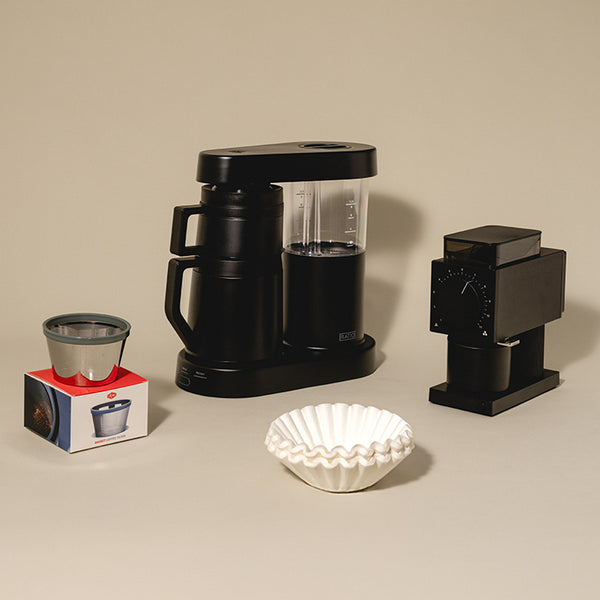
What does your morning coffee ritual look like—and how does the Ratio fit into your kitchen?
I make the coffee every morning. I wake up, get it going, take the dog out, do a few stretches, and then come back when it’s ready. I’ll bring some upstairs for Jen and have some myself.
I also have a favorite mug—handmade, a little wider with a nice taper. I’m always hoping it’s clean. We have a mix of mugs, but that’s the one I reach for.
When something is well designed, it becomes an object you want to interact with—not just use. You want to move it, feature it, rethink where it lives. Before, our coffee maker was something we hid. Now it’s something we’re excited to have out in the space.
